Strains – A Variety of Cannabis Strains for Everyone


Strains — A Variety of Cannabis Strains for Everyone
All cannabis — whether you’re using a vape pen, smoking a joint, dabbing concentrates or taking edibles — is made up of the flowers of a female cannabis plant. While the idea of “one size fits all” works reasonably well with clothing, automobiles or even prescription medications, it doesn’t apply to cannabis. That’s because there are literally hundreds of ways to express the effects of cannabis. Two individuals might smoke the exact same amount of the exact same strain and still report totally different sensations. But that’s okay! The next time one of you gets stoned, you’ll likely discover something new about yourself.
What Is a Cannabis Strain?
There are over 800 different types of cannabis known as “strains.” To put that into perspective, consider the number of beer varieties worldwide and then multiply that number by 10. That gives you some idea of just how much diversity exists within cannabis. Not everyone likes everything. It is the job of weed stores to provide customers with products that meet their expectations and fit their lifestyle. But with that said, there are no bad choices. Just because you don’t enjoy one strain does not mean that you won’t love another. At Weed Wonderland, we take pride in offering cannabis products from reputable growers whose varieties are chosen based upon their quality and consistency. We could easily sell other varieties too, but we believe in providing products that will satisfy your desire for quality and satisfaction.
The Three Main Strain Categories
Many people think that all strains fall into one of four main categories. However, thanks to hybridization, these four categories have become somewhat fuzzy. Most people agree that there are three primary categories:
- Indicas: Indica-dominant strains were traditionally used for relaxation and sedation. They grew short and compact with extremely dense buds. These varieties tended to have higher levels of CBD than Sativas, which contributed to their ability to relax and calm the mind and body. Due to their density and low stature, Indica-dominant varieties generally require less maintenance and produce fewer leaves than Sativa-dominant varieties. Indicas tend to be effective during evening hours due to their sedative properties, making them ideal for unwinding before bed or recovering from athletic activity.
- Sativas: Sativa-dominant varieties were originally used for their stimulating and energizing qualities. They grew tall with loose bud structures. Due to their height and open bud structure, Sativas tend to require more pruning and training than Indica-dominant varieties. Sativas are often recommended for daytime use due to their stimulating effects. They tend to increase energy and mental clarity. Sativas are commonly used for social gatherings and activities that require creativity or inspiration.
- Hybrids: Hybrid strains are created through the crossbreeding of Sativa and Indica varieties. The ultimate goal of hybridization is to create a variety that combines the positive aspects of both parent plants. By combining a Sativa’s energy-producing effects with an Indica’s relaxing effects, hybrids offer users flexibility in terms of application and environment. Hybrids dominate the modern cannabis industry and tend to offer a unique blend of traits that cater to a wide range of user preferences.
Why Modern Cannabis Science Distinguishes Between Plant Type vs Terpene Profiles
While many consumers view Sativa and Indica strains as fundamentally different types of plants, research has demonstrated that terpene profiles and cannabinoid ratios offer a far more reliable indicator of a product’s effect compared to its plant type. This means that two strains grown from the same batch of seeds can display vastly different effects depending on their respective terpene and cannabinoid profiles.
Terpenes are the essential oils produced by the plant that contribute to its characteristic flavor and aroma. In addition to contributing to flavor and aroma, terpenes play a significant role in shaping the overall effect of a strain by interacting with cannabinoids in order to influence their absorption and expression throughout the body. Researchers now refer to this interaction as the entourage effect. Terpenes also bind to cannabinoid receptors throughout the brain and body, thereby influencing the expression of various physiological responses.
As part of our efforts to provide greater transparency regarding each strain offered at Weed Wonderland, we publish complete terpene profiles in conjunction with every strain listing.
Cannabis Strain Names
Cannabis strains are identified by a wide array of names including:
- Cross-name — Many strains receive names that reference the actual genetics involved in their creation.
- Appearance — Some strains receive names based on their appearance.
- Flavor/Aroma — Certain strains are named for their perceived flavors/fragrances.
- Effects/Feeling — Many strains are named for the sensory experience they evoke.
- Origin Place — Other strains receive names referencing regions or countries in which they originated or were developed.
Factors That Contribute To A Strain’s Characteristic Experience
In addition to their name, several key factors determine the sensory experience provided by each strain:
1. Cannabinoid Profile — The ratio of cannabinoids present in each strain influences the potential intensity of its psychoactive effects. While THCa is the primary psychoactive compound found in cannabis, CBDa offers a moderating influence on its subjective effects. As a result, strains that contain relatively equal amounts of THCa/CBda are considered more balanced.
2. Terpene Composition — Terpenes play a critical role in determining each strain’s fragrance/flavor as well as modulating the subjective experience associated with each strain. For example, Myrcene is commonly associated with relaxation and sedation whereas Limonene contributes to feelings of upliftment/mood enhancement. Pinene may enhance cognitive function/clarity whereas Caryophyllene interacts with cannabinoid receptors located outside of the central nervous system.
3. Cultivation Method/Environmental Conditions — Although genetics account for 70% – 80% of a strain’s overall effects, environmental conditions — such as soil composition, lighting schedules, and harvesting times — can dramatically impact the final potency/aroma/experience. As such, it is crucial for users to understand how each strain is grown prior to consumption.
Using Your Intended Experience As A Guide
When navigating a large selection of cannabis strains, it can be helpful to browse according to your desired experience. Here is an example:
| Experience | What to Look For | Example Strain Types |
| Deep relaxation / sleep | High myrcene, indica-dominant, moderate-high THC | Granddaddy Purple, Northern Lights, Bubba Kush |
| Creative focus | Limonene or terpinolene-forward, sativa-dominant | Jack Herer, Durban Poison, Green Crack |
| Social and uplifting | Balanced hybrid, limonene-rich, moderate THC | Blue Dream, Gelato, Runtz |
| Stress and anxiety relief | CBD:THC ratio strains, linalool-forward | Harlequin, ACDC, Cannatonic |
| Physical comfort | Caryophyllene-dominant, indica-leaning | OG Kush, Girl Scout Cookies, Wedding Cake |
| Mild / beginner-friendly | Lower THC (under 15%), higher CBD | Penelope, Euphoria, CBD Therapy |
Classic Strains Worth Knowing
Some strains have shaped the cannabis world so significantly that they deserve their own mention. These are the genetics that most modern varieties trace back to:
- OG Kush — the backbone of West Coast American cannabis. Fuel, earth, and pine aromas with a heavy, euphoric body effect. Parent to dozens of iconic modern strains
- Skunk #1 — one of the first stable hybrid strains, developed in the 1970s. Hugely influential in European cannabis culture. Sharp, funky aroma, balanced effect
- Northern Lights — a legendary indica, developed from Afghan landrace genetics. Resinous, fast-flowering, deeply relaxing. One of the most awarded strains in history
- Haze — the original sativa-dominant variety, developed in California in the late 1960s. Parent to countless sativa and hybrid strains. Long-lasting, cerebral, energising
- White Widow — a Dutch classic from the 1990s. Crystalline trichome coverage, balanced hybrid effect, reliable and consistent
- Gelato — born in the San Francisco Bay Area from Sunset Sherbet and Thin Mint GSC. Sweet, creamy, dessert-like flavour with a balanced, happy effect. One of the defining strains of the modern era
New and Emerging Strains
The cannabis breeding world moves fast. Alongside the classics, we regularly introduce newer varieties that reflect where cultivation and genetics are heading:
- Exotic and ultra-high-THC strains — modern breeding has pushed THC percentages well beyond what was achievable a decade ago. Some current varieties regularly test above 30%
- Terpene-first breeding — a growing movement among craft cultivators prioritising flavour complexity over raw potency. These strains may have moderate THC but extraordinary aromatic profiles
- Rare and limited genetics — small-batch releases from boutique breeders. Available in limited quantities when we can source them
- High-CBD and balanced ratio strains — growing demand has driven real innovation in varieties designed for consumers who want cannabinoid balance rather than maximum THC
Our new arrivals section is updated regularly. Subscribe to our newsletter to be notified when limited strains come in.
How to Choose the Right Strain
A practical approach when you’re not sure where to start:
- Define your goal first — relaxation, creativity, sleep, social use, pain management, or simply curiosity. Your intended experience narrows the field significantly
- Consider your tolerance — if you’re new to cannabis or returning after a break, start with strains under 15% THC regardless of how appealing a 28% variety looks
- Read the terpene profile — two strains with the same THC percentage can produce very different experiences based on their terpene composition
- Check the cannabinoid balance — a strain with meaningful CBD content alongside THC will feel different from a pure high-THC variety. Neither is better; they suit different needs
- Start with one new strain at a time — trying multiple new varieties simultaneously makes it impossible to know what’s producing what effect
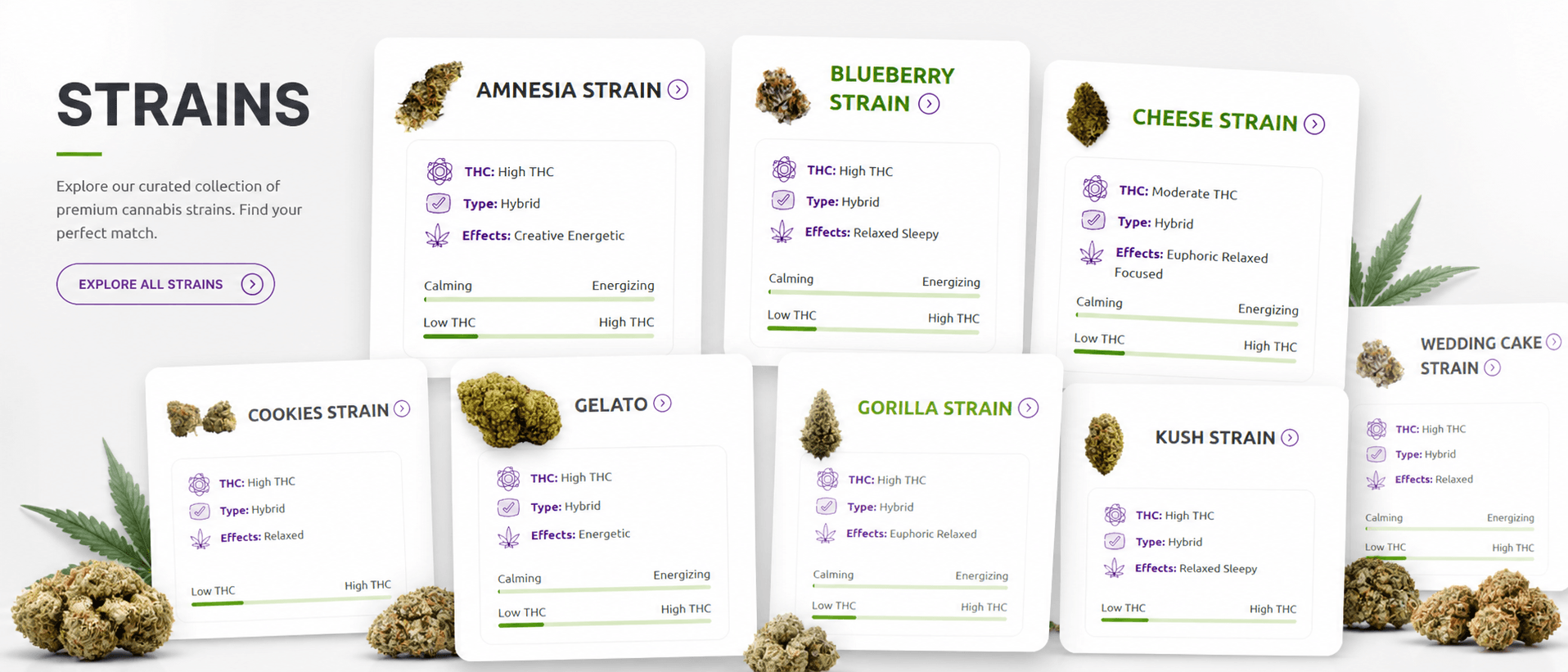
Browse our full strain catalogue above — filtered by type, effect, terpene profile, THC level, and producer. Whether you know exactly what you’re looking for or you’re exploring for the first time, every variety here comes with the information you need to choose well.